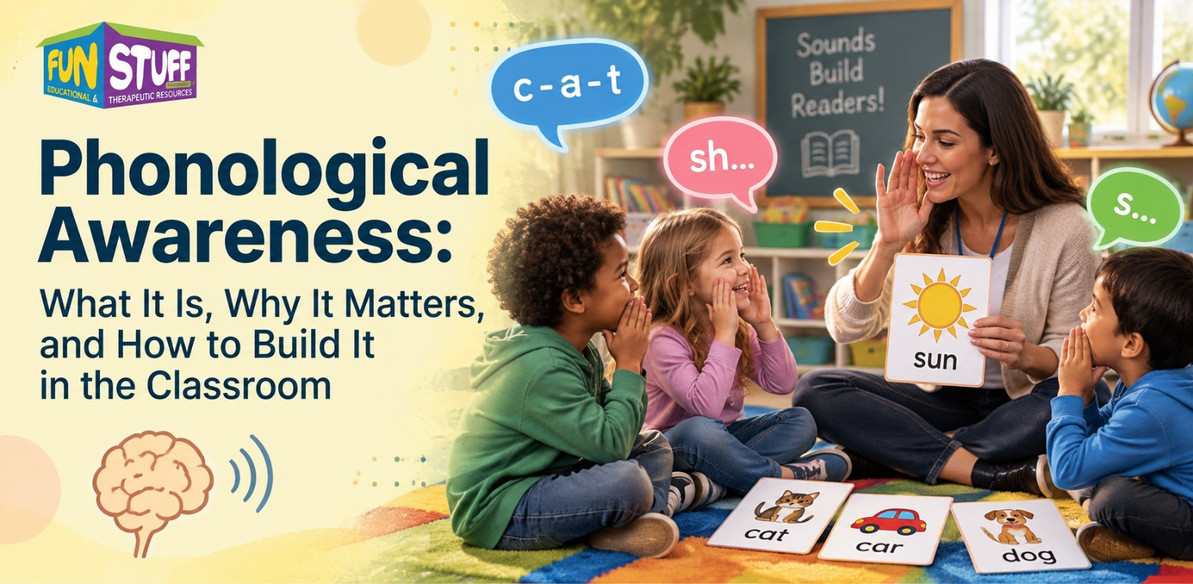
Phonological Awareness: What It Is, Why It Matters, and How to Build It in the Classroom
A Year 1 teacher once said something to me that stuck: “He can read every word on the page, but he still can’t hear that cat and bat rhyme.” She’d been turning it over for weeks. His decoding was fine. His comprehension was fine. Something underneath just wasn’t holding up, and she couldn’t quite name what.
That something, it turned out, is phonological awareness. And once you get your head around what it actually is, a lot of what you see in early readers starts making a lot more sense.
I keep running into this topic in Australian classrooms and speech therapy rooms lately, over and over. Teachers ask about it. SLPs get roped in to explain it to classroom staff. Schools are still working out where it even fits in their literacy programs. So here's my attempt at a practical breakdown: what it is, what to watch for, what you actually do about it.
So What Is Phonological Awareness, Really?
Here's the short version: it's the ability to hear and mess around with the sounds in spoken language. Spoken being the key word there. Nothing to do with print. No letters, no page. Just sound, full stop.
Under that umbrella you've got things like:
- Knowing a sentence is made up of separate words
- Knowing words break down into syllables (ba-na-na has three)
- Noticing that words can rhyme (cat, bat, hat)
- Picking out the beginning sound in a word (dog starts with /d/)
- Blending sounds together into a word (/k/ /a/ /t/ = cat)
- Pulling a word apart into its individual sounds (cat = /k/ /a/ /t/)
That last skill, working with individual sounds, gets its own name: phonemic awareness. It's the deepest end of the pool, so to speak, and it's the one that ends up mattering most for whether a kid reads and spells well down the track.
So why does it matter this much? Well, think about what reading actually demands of a child. Letters on a page have to stand for something, and that something is sound. Writing's the same deal in reverse, hear a sound, put a letter to it. Take that skill away and you're left with guesswork dressed up as reading. And kids know when they're guessing. It doesn't feel like real reading to them, even if they're getting some words right.
Why This Is Coming Up More Right Now
Phonological awareness has always mattered, obviously, but it's getting a lot more airtime across Australia these days. A few reasons for that, as far as I can tell.
First up, the national Year 1 Phonics Screening Check is rolling out across Australian states now, which means decoding is suddenly something schools have to report on, formally. And you can't really talk about decoding for long before you land on phonological awareness, whether or not that's what anyone's calling it in the staff room.
Second thing: there's just more back-and-forth happening between SLPs and classroom teachers these days about where their work crosses over, which wasn't always the case in my experience. Makes sense though; phonological awareness sits right at that overlap of speech, language, and literacy. A teacher worried about a kid is usually thinking in terms of blending and rhyming. An SLP looking at the exact same kid might be thinking about speech sound development or phonological processes. Same child. Different words for roughly the same problem. Once both sides twig that they're circling the same thing, everything moves faster.
And then timing. This one might matter more than the other two combined, honestly. Do the work before school or in the early years, and it seems to count for a lot more than doing it once a child's well into primary school. That window is smaller than most people assume. Miss it and you end up playing catch-up for years, not months.
What It Looks Like When Something's Off
Not every kid who struggles with reading has a phonological awareness problem hiding underneath. But when it is there, you tend to see roughly the same handful of red flags, again and again.
Preschool and Kindy
- Struggles to join in with rhyming games or rhyming books.
- Can't clap syllables reliably, or loses count of how many are in a word
- Doesn't seem to notice when words start with the same sound
- Finds blending sounds into words hard, even in simple games
None of it's obvious at first glance, either. Some of these kids talk your ear off. Confident, chatty, clearly bright. And underneath all that chatter, the actual sound skills just haven't clicked yet.
Year 1 and Year 2
- Reading is slow and effortful, with a lot of guessing from pictures or context.
- Spelling looks inconsistent in ways that seem almost random, because really the child's guessing rather than listening for sounds.
- Blending sounds to read an unfamiliar word is genuinely hard for them.
- The child can memorise a set of words but comes unstuck the second something new turns up.
Give a kid with decent phonological awareness a word they've never laid eyes on, and they'll usually give it a crack, sound it out, and get somewhere close. Give the same word to a kid without that skill, and mostly you just watch them stall out.
Through Primary School
Some kids get remarkably good at masking this for years, especially the ones with a strong vocabulary and decent comprehension to fall back on. Works fine, right up until it doesn't. Texts get longer. Spelling demands ramp up. And all of a sudden the gaps that were quietly there the whole time can't be ignored anymore. A fair chunk of the spelling struggles you'll see in Year 5 or 6 classrooms trace straight back to phonemic awareness that nobody ever sat down and actually taught.
What Teachers Can Do About It
Good news first: phonological awareness is teachable. Properly teachable, not just theoretically. Most kids get there with the right kind of practice; it's not automatic for every single one of them, but it's not some unsolvable mystery either. So, where do you actually start?
Keep It Oral and Playful
Sound, not print, remember. So the best activities never touch a worksheet. Rhyming games. Songs. Clapping out syllables. Spotting the odd word out in a list. No pen needed. No screen needed either, for that matter. Works just as well in the morning circle, during transitions, and even in the car on the way to school. Basically, the more playful it feels, the more it actually gets done, which sounds obvious when you say it out loud but somehow gets forgotten constantly.
Build Simple to Complex
There's a rough order things develop in: words first, then syllables, then onset and rime (fancy term, just means the beginning sound of a syllable versus everything after it), then finally individual phonemes. Aim a bit above where a child currently sits, not miles above. Try jumping straight to phonemes with a kid who still can't clap out syllables and, honestly, you'll probably just lose them.
Tie It to Your Phonics Program
Quick clarification here because people conflate these two constantly. Phonological awareness and phonics are not the same thing. One's about sound. The other's about letters. Different animals. But teach them together and they genuinely lift each other up. So when you're covering a letter-sound correspondence in phonics, slot in a bit of oral phonological awareness alongside it, spot that sound somewhere else, think up more words with it, isolate it out loud. Small tweak, decent payoff.
Use Games That Demand Active Listening
Card games where kids have to sort, match, or pick out words by sound tend to smash passive listening activities in terms of what actually sticks. The Phonological Awareness Fun Decks from Super Duper Publications, sold through Fun Stuff Educational and Therapeutic Resources, are basically built for this exact purpose. Each deck zeroes in on one skill, rhyming, beginning sounds, blending, or segmenting. Take your pick, and the illustrated cards hold a kid's attention far better than sitting and listening ever manages. There's a Secret Decoder built into the set too, so kids can check their own answers as they go. Takes the pressure off and, honestly, speeds the whole thing up.
What Speech Pathologists Can Do
For most SLPs I've come across, phonological awareness isn't some side interest; it's pretty much the backbone of literacy work, and it's constantly tangled up with speech sound therapy on top of that. Here's what tends to come up most in the clinic.
Start With Assessment
Don't jump straight into intervention. Work out first where a child actually sits, using something like the CTOPP-2 or the Sutherland Phonological Awareness Test (SPAT-R), both of which cover words, syllables, onset-rime, and phonemes. Get that picture sorted and, more often than not, the rest of the plan more or less writes itself.
Phonological Awareness Fun Decks
The Phonological Awareness Fun Decks from Super Duper Publications cover rhyming, beginning sounds, final sounds, blending, and segmenting, and there's barely any prep required to run them. Handy if you've got several kids chasing similar goals, because one deck gives you a bunch of game variations that hold up across a pretty wide age range.
Structured Literacy Intervention
Some kids need more scaffolding than a deck of cards can give them. That's where the Phonological Awareness and Literacy resources through Fun Stuff come in, workbooks and activity resources that build phonological awareness right alongside early literacy in a more step-by-step way. They hold up well as take-home work between sessions too, so practice doesn't just stop dead the second the child walks out the door.
Bringing Classroom Teachers Into It
Here's one of the highest-leverage moves an SLP can make in a school: hand teachers the vocabulary and a handful of simple activities so they can reinforce this stuff during the school day, no specialist training required. Even five minutes tucked into a morning routine adds up over a term more than people expect. The Phonological Awareness Fun Sheets are simple enough that teachers and parents can just grab them and go.
The Teacher-SLP Partnership
This is genuinely one of those spots where two heads beat one, no exaggeration. SLPs bring the specialist assessment and the targeted intervention. Teachers bring the daily, embedded, in-the-room practice that happens whether or not anyone's watching. Get both running at the same time and kids end up with way more exposure than either side could pull off solo.
A lot of schools, especially out in regional and rural Australia, don't have an SLP on site at all, and that's just the reality for a lot of communities. For those schools, decent resources in the hands of a teacher who actually knows what they're doing can genuinely shift things. Nothing about the activities is complicated. The progression's well understood by now. And early, targeted practice does actually work; that bit really isn't up for debate.
A Few Questions That Keep Coming Up
Is phonological awareness the same as phonics?
Nope, though people mix them up all the time. Phonological awareness works purely with sound; you could technically do the whole thing with your eyes shut. Phonics always involves print, since it's about how sounds map onto letters and letter combinations. Both matter for reading, and a kid with strong phonological awareness tends to pick up phonics quicker as well.
My student can rhyme but struggles to segment. Is that unusual?
Not really; it's actually pretty common. Rhyming shows up earlier in the progression. Segmenting individual phonemes comes later, and it's harder. So you'll get kids who are genuinely solid at rhyming and still need explicit teaching once you get down to the phoneme level. That's exactly why it's worth figuring out where a child actually sits, rather than just asking whether they “have” phonological awareness like it's some single switch that's either on or off.
How do I know if a child needs an SLP referral?
A few things worth watching for: falling noticeably behind peers on phonological tasks, phonics instruction that just isn't landing the way you'd expect, or broader concerns about speech sounds or language generally. Any one of those on its own is enough to justify a referral. An SLP can pin down exactly where the gaps are and build a plan around them. And earlier genuinely does beat later here, by a fair margin, not just a little bit.
Where can I find phonological awareness resources in Australia?
Fun Stuff Educational and Therapeutic Resources stocks a decent range for both classroom and clinic use, including the Super Duper Fun Decks, activity books, and other literacy support materials. Worth a browse through the full phonological awareness and literacy range over at funstuff.com.au.
Back to That Year 1 Teacher
She ended up referring him to the school's SLP. Turned out his phonological awareness was well below where it should've been for his age, even though nothing else about him had raised so much as a flicker of concern. Six months went by, split between SLP sessions and steady classroom practice, and he came out the other side tracking right alongside his peers.
He'd been working hard that whole time, for what it's worth. He just needed someone to actually spot the gap and go after it directly instead of guessing.
That's the whole point of good phonological awareness work when you get down to it. Catch the missing piece early, before it snowballs into years of struggle, and give kids a genuine shot at reading and spelling with real confidence, not just muddling through.
If you're after resources to support phonological awareness in your classroom or clinic, Fun Stuff Educational and Therapeutic Resources has practical, professionally chosen tools ready to go.
Recent Posts
-
Phonological Awareness: What It Is, Why It Matters, and How to Build It in the Classroom
A Year 1 teacher once said something to me that stuck: “He can read every word on the page, but he s …11th Sep 2026 -
Emotion Regulation in Children: Practical Strategies for Teachers & Therapists
It was a Tuesday morning. Math lesson, mid-session. A Year 3 boy, a bright kid who generally gets on …11th Sep 2026 -
Auditory Processing Disorder in the Classroom
Auditory Processing Disorder in the Classroom: A Practical Guide for Australian Teachers and Speech …14th Aug 2026