
Pragmatic Language Skills: Guide for Teachers & Speech Therapists
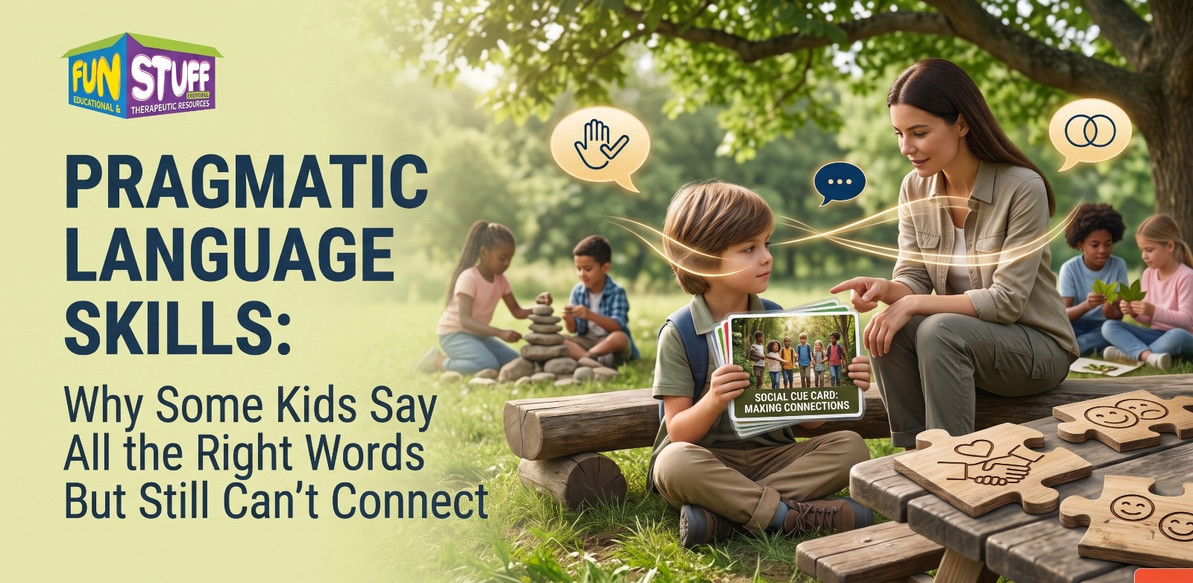
Pragmatic Language Skills: Why Some Kids Say All the Right Words But Still Can’t Connect
He was seven. Smart kid, read well above his level, could rattle off dinosaur names all day, and could hold his own in a conversation with an adult.
But at lunch, the other kids kept their distance. Group projects were a mess. He talked over people, missed the moment when someone wanted to change the subject, and laughed at the wrong times. Teachers liked him fine. The kids his own age found him exhausting.
Nobody thought to check his language. Why would they? His language sounded excellent.
Except it wasn’t, not all of it. His vocabulary and grammar were genuinely strong. What was missing was pragmatic language — the social side of communication, the part that tells you how to say something, when to say it, and to whom. That gap was quietly making school miserable for him.
Pragmatics appears to be a type of communication that people tend to shy away from even though it decides if a kid’s school day is going to be a good or bad one. Here is what you should know about pragmatics, its symptoms, and the functions of both teachers and therapists.
So What Is Pragmatic Language?
When you ask anyone about language difficulties, they will tell you about children that pronounce words incorrectly, that have limited vocabularies, or cannot construct sentences. That is all correct and should be taken into consideration. However, pragmatics is something completely different. Pragmatics is what you can call the social side of language; it determines the way in which language is used according to the context of communication.
That includes things like:
• Knowing when to speak and when to just listen
• Reading the room and adjusting what you say based on who you’re talking to
• Understanding that words shift meaning depending on context (“Can you pass the salt?” isn’t really a question about your abilities)
• Picking up on a facial expression, a shift in tone, body language
• Staying with a topic, then moving off it without it feeling like a jolt
• Catching a joke, sarcasm, or something that’s implied but never actually said
• Starting a conversation, keeping it alive, and ending it without it feeling awkward.
This is something that most children discover through playing, observing adults and through a lot of practice and error. However, there are children who do not do any of these things instinctively; there are kids with autism, ADHD, language disorders, social anxiety or no diagnoses at all who will not learn this in any intuitive way.
This is why we have speech-language pathologists and teachers.
Why Pragmatic Language Matters More Than People Think
People tend to file pragmatic language under “will probably sort itself out.” Mostly, it doesn’t. And leaving it alone tends to cost a lot more than anyone expects going in.
On the academic side, this decides whether a child can actually join a class discussion, cope in a group, ask for help when lost, or follow an instruction that isn’t spelled out word for word. Take something as simple as a teacher saying “let’s start wrapping up.” No presents involved, obviously, but a child with pragmatic difficulties can hear that phrase and have absolutely no idea what they’re meant to do next.
In terms of socialization, it is more difficult to observe. The child with poor pragmatic abilities will end up isolated from the group of friends not necessarily because of any deliberate exclusion but simply because his/her presence creates an element of unpredictability. Social cues will be misunderstood, conversation will become confusing, jokes will not be recognized as jokes, and misunderstandings will not be repaired after that. At some point, this will happen so often that most children will just stop trying. Lunch time will become something endured alone and group activities dreaded.
And emotionally, years of this friction don’t just disappear. It piles up into anxiety, a battered sense of self-worth, sometimes outright refusal to go to school. Imagine being told over and over that you’re rude, or annoying, or “weird,” while having no real idea what you did wrong. That’s a heavier weight to carry than most adults around that child ever clock.
Get support in early enough and the whole trajectory shifts. It won’t be perfect, and it won’t happen overnight. But it counts for something real.
What It Looks Like in the Classroom
Pragmatic language difficulties rarely show up with a label attached. It’s the kid who talks too much. The one who can’t stop interrupting. The one who takes “break a leg” literally and panics. The one who answers every question in one word because they can’t tell how much detail is expected. The one who walks off mid-conversation, or genuinely doesn’t understand why their classmate is upset with them.
A few patterns come up again and again.
The Interrupter
This isn’t rudeness, or at least not usually. For a lot of children with pragmatic difficulties, the real issue is that they can’t read the small conversational signals that tell you when it’s your turn to talk — changes in tone, eye contact, a pause. If a child isn’t picking those up, they’re not being deliberately rude. They’re working with half the information everyone else has.
The Monologuer
This is the kid who can tell you everything there is to know about Minecraft, sharks, or the offside rule, in more detail than anyone asked for, without noticing that the person across from them checked out about four minutes ago. Reading whether someone’s still interested is a pragmatic skill in itself. So is knowing when to stop talking.
The Literal Thinker
“Pull your socks up.” “Give me a hand.” “It’s raining cats and dogs.” English is full of expressions that make zero literal sense, and for kids with strong pragmatic difficulties, these are landmines. They understand the individual words fine. What they don’t get is what those words mean together, in context. This shows up in reading comprehension too — it’s often why a child who can decode text perfectly still struggles to actually understand what they’ve read.
The One Who Can’t Read the Room
They crack a joke at exactly the wrong moment. They bring up a topic everyone else has moved on from. They don’t seem to notice a teacher’s annoyed, or that a classmate is upset. It isn’t insensitivity, not in the usual sense of the word. It’s a genuine difficulty picking up on the nonverbal, contextual cues that tell you what’s actually going on in a room.
For Teachers: What You Can Do in the Classroom
You’re not a speech pathologist, and nobody expects you to be. But you spend more waking hours with these kids than almost anyone else, and what you do day to day makes a real difference — most of it without needing extra time or resources.
Say the unwritten rules out loud. Most of us never actually teach these rules because we assume every child already picked them up. That assumption is exactly what trips kids with pragmatic difficulties up. So spell it out plainly. Tell them when someone’s talking, you look at them and wait for a gap before jumping in. If they want to shift the topic elsewhere, they can open with "anyway" or "speaking of which". And if the joke falls flat, that’s no big deal because it just means the joke did not hit its mark.
This can be somewhat uncomfortable. That is precisely what many children require.
Practice it, don’t just explain it. A lecture about social rules rarely sticks with a child who’s already struggling to read context in the moment. What tends to actually work is running through it hands-on, over and over, in a setting where getting it wrong costs nothing. Act out a conversation together. Demonstrate the process of belonging to a group, or changing the subject without it seeming too sudden. You can practice what to say if your friend is angry. None of this requires a more formalized setting, a small group, or even a counseling session – even five minutes within a social-emotional classroom check-in will do just fine.
Keep the correction private. Pulling a child up in front of the whole class over a social slip mostly just adds humiliation, it doesn’t teach them much. A quiet word after the lesson does far more. Try something along the lines of “I noticed you spoke over Sarah earlier, let’s figure out a better way to handle that next time” — and steer the conversation toward what to try, rather than dwelling on what went wrong.
Narrate the social situation as it happens. Some kids simply can’t read a room yet, so give them the words for it. Mention that Tom seems quiet today and might want some space. Point out that Sarah’s smiling as she says that, so she’s joking, not being serious. Note that the group packing up their things means the activity’s ending. Say it plainly, without making a show of it, and you’re handing them a framework for reading situations they’d otherwise miss entirely.
Build structure into group work. Open-ended group work is often the hardest setting for these kids, because it means negotiating roles and reading dynamics in real time. Assigning clear roles — timekeeper, recorder, presenter, facilitator — takes a lot of that ambiguity off the table and gives every child something concrete to hold onto. It also frees up enough headspace that actual learning can happen.
For Speech Therapists: Targeted Intervention That Actually Works
Pragmatic language intervention works best when it’s direct, structured, and tied to real situations a child actually runs into. Here are a few resources that keep coming up in clinical settings.
Photo Practical Pragmatics Fun Deck — this uses real photographs instead of cartoons, and that distinction matters more than it sounds. Kids relate to a photo as a real situation, not an abstract illustration. Each card pairs a photo with a prompt targeting one of seven pragmatic categories, structured enough for a focused session, flexible enough to work across ages and ability levels.
Say & Do Positive Pragmatic Games — game-based practice across ten pragmatic skill areas. The game format does a lot of work here. Kids with social communication difficulties often shut down the moment something feels like “therapy,” but they’ll engage when it feels like play. These boards let you target real goals without the child feeling like they’re being drilled.
Social Skills Quick Take Along Mini-Book — a pocket resource for therapists moving between settings all day. It covers responding in social situations, initiating and joining interactions, and navigating common scenarios. Small enough to grab in the five minutes before the next kid walks in.
Talkabout by Alex Kelly — one of the more comprehensive social communication programmes out there, for therapists running structured groups. Over 60 activities covering self-awareness, body language, conversational skills, and assertiveness. Well established, practical, and adaptable across children, teens, and adults. Worth having if you’re running group social skills work in a school or clinic.
Neurodivergent Communication & Social Skills Mega Pack — a ready-to-go bundle from Fun Stuff Educational & Therapeutic Resources, pulling together 11 resources across pragmatic language, inferencing, listening, and social understanding, built specifically for autistic and neurodivergent kids. Less sourcing, less setup, more actual time with students.
Thumball range — including the Who Are You? Thumball and the general social conversation Thumball, genuinely useful for group sessions and low-stakes conversation practice. Kids throw, catch, and respond to whatever prompt lands under their thumb. It’s active, a bit unpredictable, and generates exactly the kind of back-and-forth that pragmatic skills are actually built through. Works as a warm-up, a session closer, or a classroom icebreaker.
The School and Clinic Connection — Why It Has to Be Both
Pragmatic language doesn’t get built in a therapy room and then just transfer to the playground on its own. It needs practice in real social settings — the classroom, the corridor, the canteen, group activities. That’s where the actual work happens.
That’s also why the most effective support is a genuine partnership between the speech therapist and the classroom teacher. The SLP figures out the specific skills to target and runs structured practice. The teacher backs it up in class, naming the social rules, narrating situations, building structure into group work. When both are happening at once, the child gets consistent support across every setting they’re in. That’s when real change shows up.
For school-based speech language pathologists, this usually entails getting a few minutes to chat with the classroom teacher. Tell her what your goals are. Provide her with one or two tangible actions that she can do in the classroom, as opposed to an abstract resource. The brief conversation will yield better results than an unread report locked away in a file cabinet.
A Few Questions That Come Up
Is pragmatic language difficulty the same as autism?
Not exactly. Differences in social communication are a core feature of autism, but pragmatic difficulties show up in plenty of children without an autism diagnosis too — kids with ADHD, language disorder, anxiety, or no diagnosis at all. The support strategies stay largely the same regardless of the underlying cause, which is part of why this is worth understanding even if autism isn’t your main focus.
How early can pragmatic language difficulties be identified?
Earlier than most people assume. Signs can show up in preschool — a child who doesn’t point to share interest, who struggles with pretend play, who talks at other kids rather than with them. By early primary school, the patterns are usually pretty clear, especially in group and classroom settings. Support started early tends to go a lot further. Waiting until secondary school, once the social demands have ramped up and the child has spent years feeling like something’s wrong with them, makes everything harder.
My student seems fine one-on-one but falls apart in groups. Is that pragmatics?
Absolutely. One-on-one conversation is much easier – only one person to follow, one flow of signals, one rhythm of taking turns. Group conversation involves following more than one speaker, understanding the dynamics of the situation, learning how to take part and withdraw without throwing the discussion off course. A kid can deal easily with one-on-one conversation and yet be utterly lost when there is a third party present. Both situations are important and require different skills.
Where can I find pragmatic language resources in Australia?
Fun Stuff Educational & Therapeutic Resources stocks a wide range of social skills and pragmatic language resources chosen specifically for school and clinic use, from structured programmes like Talkabout through to game-based tools, card decks, and bundled packs. Browse the full social skills and pragmatics range at funstuff.com.au and filter by age or skill area to find what fits your setting.
Back to That Seven-Year-Old
He didn’t need new friends, or stricter discipline, or a different school. He needed someone to spell out the rules everyone else had somehow picked up without being told.
Once a speech pathologist started working with him on pragmatic language, naming the hidden social rules, practising conversation in a structured way, giving him language for situations he couldn’t read on his own, things started to shift. Slowly, not dramatically. But a couple more kids started turning up at his lunch table.
That’s what this work does. It doesn’t fix everything. But it hands kids the tools to start building something for themselves.
If you’re looking for resources to support pragmatic language work in your school or clinic, Fun Stuff Educational & Therapeutic Resources has it in one place — practical, professional-grade tools chosen specifically for Australian teachers, speech therapists, and the kids they work with every day.
Recent Posts
-

How Shared Play Builds Language Skills in Children
Children learn language through real interactions. A child may pick up a new word from a book, but t …12th Oct 2026 -

Word Finding Difficulties in Children: Signs, Strategies and Activities
A child with word finding difficulties knows a word but can't get to it when they need it. They migh …9th Oct 2026 -

School Readiness in Australia: What to Know
Every year, sometime in late January, prep teachers all over Australia meet their new class for the …15th Sep 2026