
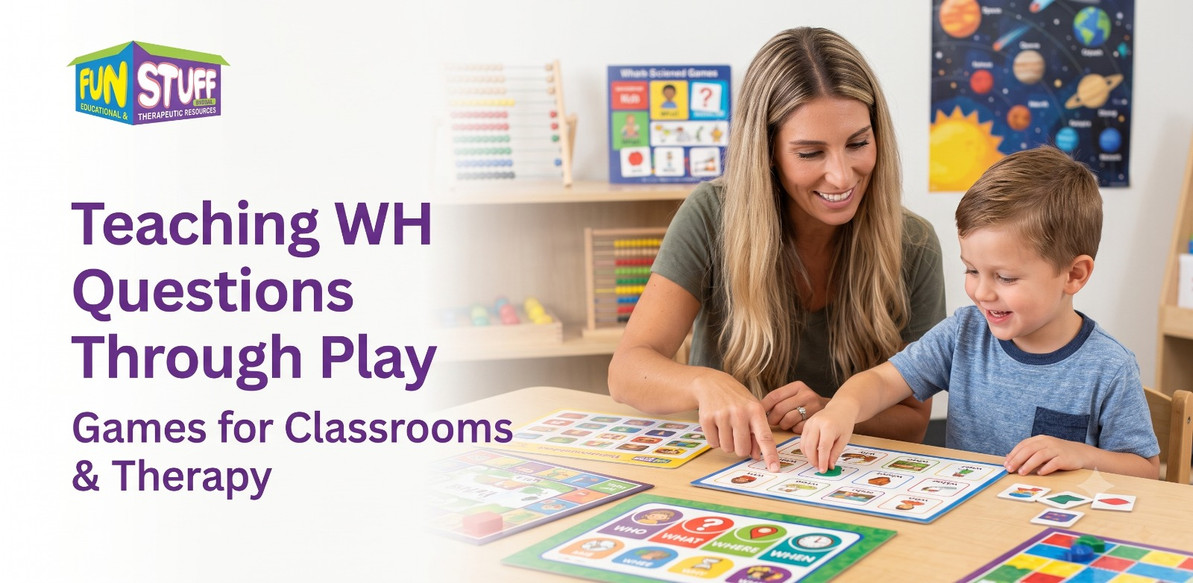
Teaching WH Questions Through Play: Two Games for Classrooms and Therapy
Anyone that works with children knows that questions are everywhere. Teachers ask questions to engage their class. Children ask questions during their play. Speech pathologists incorporate questions to develop language skills. Parents ask questions to their children every day.
Who, What, Where, When, Why questions appear simple, but answering them aids in the development of a young child’s language. They grow a child’s ability to process a story, carry a conversation, follow directions, and develop their own ability to verbally sort and describe their thoughts.
Answering WH questions is natural for some children but needs more help for others. Some of the kids who have problems in speech, autism, intellectually disabled children and those who face difficulties in communicating would need direct teaching, visual aids and repetition before they start answering them automatically.
Practicing is not necessarily something boring and testing. WH questions can be learned through different games.
The WH Chipper Chat® Game and the "WH" Question Blast-Off Board Game are two widely known learning tools. Both can be found in Fun Stuff Educational & Therapeutic Resources and are ready to use in classrooms by teachers, speech pathologists, and even families.
Why Learning to Answer WH Questions is Important
Answering WH questions is more than just a language game. They are used throughout the day.
A child answering “Who is in the story?” during reading time is an example of a WH question. “What do we need for this activity?” is another WH question that can be asked in a classroom setting. “Where is your lunch box?” and “Why are you upset?” are examples of WH questions that can be asked in a variety of settings.
Before being able to answer WH questions, children first have to understand the WH-word and the rest of the sentence. After that, they have to find the required information and answer accordingly. Responding to WH questions develops both receptive and expressive language.
The purpose of each WH question is as follows.
- Who inquires about people and/or characters.
- What concerns objects, actions, or ideas.
- Where is about a location.
- When is about a specific time.
- Why is about a reason.
Children generally find it less difficult to answer Who and What questions. These typically refer to a tangible person, object, or action. Reasoning to answer When and Why questions is typically more difficult for children.
WH questions can be used across classroom discussions, routines and learning activities, including language, science, maths and history.
Questions that teachers ask after a book has been read may include:
- Who was the main character?
- What happened at the beginning?
- Where did the story take place?
- When did the problem happen?
- Why did the character make that choice?
The goal of each of these questions is to assist children in learning to read and articulate their thoughts to others effectively. The ultimate goal will be to aid in incremental steps toward preparation for advanced comprehension tasks.
Answering WH questions also aids in social communication. Once children understand and master these questions, they will be able to communicate with others in the form of conversation. They will be able to report their weekend, describe a problem, or offer to help and give their viewpoint on different issues.
Children with language delays may benefit from regular, supported WH-question practice. A short game during small-group activities can be a fun way to keep these skills active.
WH Questions in Speech Therapy
WH questions are included in speech therapy for several reasons. First of all, they facilitate the achievement of various objectives related to language skills. Such objectives include comprehension of oral questions, choice of the appropriate answer, and formulating an answer in a full sentence.
Support levels can be adjusted based on the individual child. For instance, a therapist might begin by showing the child image choices and asking, “Who is eating?” When the child displays more confidence, the therapist may ask less structured questions, like, “Why do you think he is eating outside?”
Moving from the more structured to the less structured question can help children develop longer and more detailed responses. This can also help the therapist see how the child is developing over time.
Games can create a relaxed environment where children have the opportunity to answer many questions in the time it may take to answer only a few on a worksheet. Taking turns and participating in a game can be a more engaging way to practise answering questions.
WH Chipper Chat® Game: Focused Practice That Feels Like Play
The WH Chipper Chat® Game is a great hands-on tool to help children learn to answer WH questions. The game includes questions on who, what, when, where, and why and comes with game boards, a set of magnetic chips, a magnetic wand, and a foam die.
Depending on the child’s needs, the game can be used different ways. A teacher or speech pathologist can use “where” questions, or once the child is more advanced, use a variety of questions.
Why WH Chipper Chat® Is Effective in Therapy
WH Chipper Chat® can easily be integrated for either individual or small group use in therapy. The flexibility built in to the product allows the therapist to easily modify the activity using visual options, modeled responses, or by restating questions to encourage the use of complete sentences.
Most therapists will start with a simple, “who” question using a picture of a person the child knows. Once the child is comfortable, they can then advance to “who” questions with book characters, community helpers, and people from various situations.
The game format of WH Chipper Chat® is designed to help keep practice fun and engaging for the children, making them more likely to answer a larger number of questions. The children are given the opportunity to practice “who” questions without the monotony of a repetitive activity.
Why WH Chipper Chat® Is Effective in Schools
WH Chipper Chat® is a great resource for small group literacy sessions, in-class support, and learning support classroom rotations. It can also be used by children during free time if they finish their class work early.
Using the same WH Chipper Chat® questions that a child is using in their speech sessions provides the teacher an additional opportunity to help the child achieve their speech and language goal.
The flexibility and easy instructions built into WH Chipper Chat® allows not only the teacher, but the teacher’s assistants and support staff, to use the activity, providing the school additional language practice without the need for a complex program.
WH Question Blast-Off Board Game
WH Question Blast-Off Game brings the fun of space to the practice of WH questions. Answering questions throughout the game makes learning language less of a chore and more of a game.
The game is great for a small group. Its space design will appeal to kids that enjoy rockets and planets and to kids that enjoy astronauts.
What Makes WH Question Blast-Off a Great Game for Therapy
The game more than helps with the practice of WH questions. It also helps with the social skills of waiting, listening, and responding to the players with the game. Skills like these are important for kids that are working on the social side of communication.
The game is great for a therapy session as a fun way to get the kids to warm up to the work at the table, as a work break in the middle of the session, or as a fun way to end the work at the table. The game is a great motivator for the kids that are tired of the work because of how many times you use flashcards in a therapy session.
The game can be adapted by the therapist to change the level of the WH question by allowing the kid to take their time to answer, use a visual to support the question, or tell why they chose the answer they did. This game works for all levels of language.
What Makes WH Question Blast-Off a Great Game for the Classroom
The game works for a small group of kids, and a teacher, teacher aide, or parent helper can run the game as a literacy rotation or give the game as a targeted support option.
A space-themed classroom unit would be a good fit. Teachers can include the game with books, activities or even discussions about planets, scientists, and astronauts. This keeps the students else engaged and allows them to incorporate WH questions.
The game can be modified for specific students and their needs. The students can answer independently or require some sort of assistance such as a peer, sentence starters or picture choices. The game keeps students engaged regardless of the modifications.
Games are a good and fun way of incorporating WH questions in class. The following tips can get teachers and speech pathologists started toward their goal.
Focus one question type WH at a time
Incorporating all WH question types at the same time can be a daunting task to some students. Start with “who” or “what” then add the rest as the student gains more confidence.
Incorporate visual supports
Make the meaning of each WH question word clearer with small visual cards. Who can be paired with a person and where with a picture of a place. The visual cards can stay on the table and can removed as the student becomes more independent.
Incorporate the use of known topics
While students are answering questions, they are more confident when the questions relate to a topic they are familiar with or take a personal interest in. These can be about stories, classroom routines, or other activities.
Provide sufficient processing time
Some kids require additional processing time before verbalizing a response. Instead of immediately rephrasing or clarifying, allow for a few seconds of silence before moving on.
Demonstrate complete response
One-word responses can be expanded by adult modeling. After responding with "park," an adult can restate the child's full response by saying, "They went to the park." Over time, children begin to self-correct to longer, complete responses.
Document response trends
Notes can be used to record response trends, like the number of responses given with a prompt, independent responses, or unanswered response. It can help determine the type of response given and can be useful during family goal meetings and to determine the focus of the next session.
Practicing WH Games in School, Therapy, and Home
One of the main advantages of gaming for skill practice is the ability to practice the same skill in multiple environments. A speech pathologist can introduce WH in the therapeutic setting, and a teacher can incorporate a WH game during a reading lesson. Parents may introduce the same language during family practice time.
The ability to practice WH in multiple environments supports the ability for children to independently use WH response in their everyday environments.
For schools, this also creates a connection between learning in the classroom and learning supports available through speech therapy. Teachers and speech pathologists will use consistent language in addition to the same visual prompts and modeling. Learning for the child will be more consistent.
Choosing between WH Chipper Chat® and WH Question Blast-Off
Both of these activities support the development of WH questions; however, both provide a different way to practice.
WH Chipper Chat® is useful for focused individual or small-group work. This is especially useful when either a teacher or speech pathologist wants to work on one particular question type and has the opportunity to provide a lot of practice.
WH Question Blast-Off is useful for more active small-group work. Its space theme and board-game format can help sustain children’s interest while they practise WH questions.
It is likely that both would be a welcomed addition in either a school or a clinic. Chipper Chat® would be useful for focused work, while Blast-Off would be useful for small-group activities in a classroom or therapy setting. Having multiple resources allows for varied practice and provides a break from the focus of work.
In Conclusion
WH questions are essential for communication and active participation in the classroom.
Both the WH Chipper Chat® Game and the WH Question Blast-Off Game provide an engaging way to practise WH questions in classroom and therapy settings.
Explore Fun Stuff’s Super Duper Publications range and Questioning Skills resources to find games that support your students’ communication goals.
Frequently Asked Questions
What is the target age group for the WH question games?
These games can be used with early learners and primary age children. These games can also be modified for older children who have difficulties with WH questions.
Can these games be used by classroom teachers or just by speech therapists?
Both these games can be used by classroom teachers, teacher aides, speech pathologists and even by parents as well. These games are easy to implement and can be played to cater for different goals of language teaching.
How do these two games differ from each other?
These two games cover WH questions, but they have a different game play. The first game, called WH Chipper Chat®, can be played to cater for more individualized practice, while WH Question Blast-Off is a game that combines a space theme board game that can be used for small group work.
How many students can these games be played with?
Wh Chipper Chat® can be played with 1-5 students, while WH Question Blast-Off can be played with 2-6 students, making both these games suitable for a practice group or classroom station.
Do these games include difficult question types, such as "why"?
Yes. These games can be employed to practise various WH questions, which can include easier WH questions such as "who" and "what", but also more complicated questions such as "when" and "why".
Can these games help achieve both receptive and expressive communication goals?
Yes. The activity can be modified in order to fit either of these objectives - educators may provide multiple choice answers, or require children to make a complete verbal statement.
From where can schools and clinics purchase these games?
Both games can be purchased from Fun Stuff Educational & Therapeutic Resources. In addition, Fun Stuff provides school ordering and NDIS ordering options for eligible purchases.
Recent Posts
-

How Shared Play Builds Language Skills in Children
Children learn language through real interactions. A child may pick up a new word from a book, but t …12th Oct 2026 -
Word Finding Difficulties in Children: Signs, Strategies and Activities
A child with word finding difficulties knows a word but can't get to it when they need it. They migh …9th Oct 2026 -
School Readiness in Australia: What to Know
Every year, sometime in late January, prep teachers all over Australia meet their new class for the …15th Sep 2026