
Auditory Processing Disorder in the Classroom | Fun Stuff
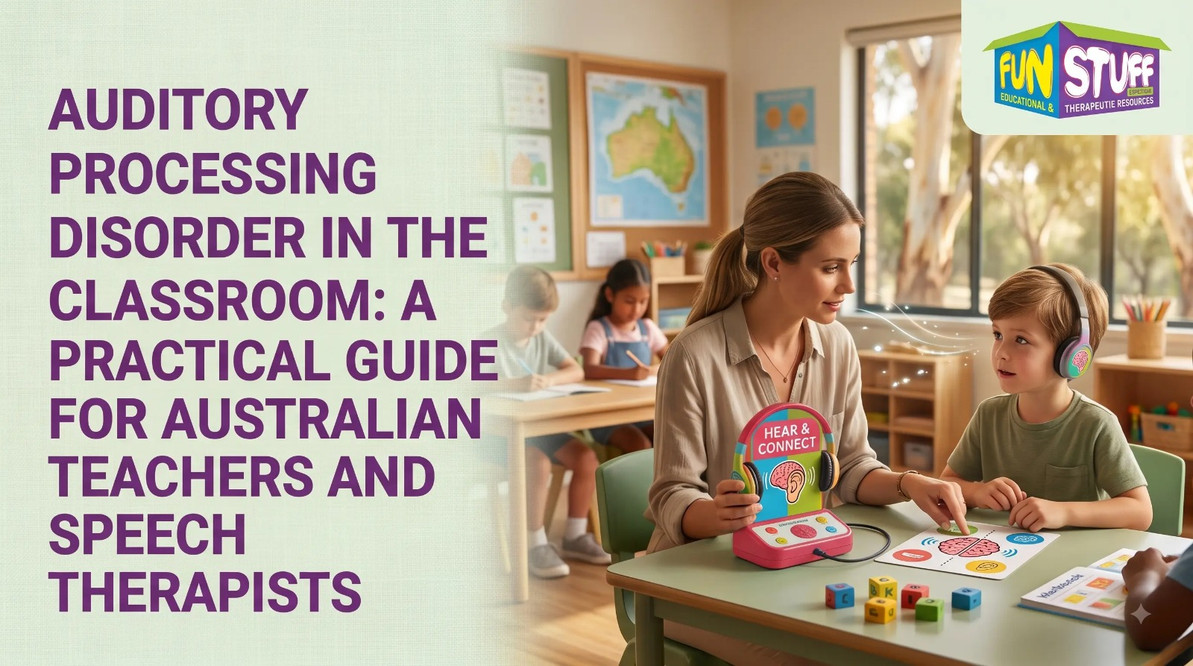
Auditory Processing Disorder in the Classroom: A Practical Guide for Australian Teachers and Speech Therapists
There is a student in your class. She sits near the front. She tries hard. She is not rude, not distracted by her phone, not disinterested. But she consistently misses the second half of your instructions, gets confused when two things are said quickly, and looks blank when the rest of the class seems to understand.
She does not have a hearing problem. Her ears work perfectly fine.
What she may have is Auditory Processing Disorder — and in most Australian classrooms, it goes unidentified for years.
This guide is for teachers and speech therapists who want to understand what APD actually looks like, how to spot it, and what to do about it — with practical strategies that work in real classrooms with real timetables and real budget constraints.
What Is Auditory Processing Disorder?
Auditory Processing Disorder, or APD, sometimes called the Central Auditory Processing Disorder, is where the brain does not process or decode the sounds from the ears. In this context, it should be known that the difficulty lies not in hearing the sounds through the ears but in processing them in the brain.
In short, one can compare it to communicating using the telephone, where the device works normally, but the information is somehow distorted once transmitted. This can be compared with APD, as the ears are working fine in capturing the sounds but are distorted when processed by the brain.
APD affects roughly 5% of school-age children, which means in any given Australian primary school, there are likely several students sitting in classrooms right now struggling with something their teachers may not fully understand.
It is also commonly misidentified. The profile of a child with APD distracted, struggling to follow instructions, and inconsistent, can look a lot like ADHD, language disorder, or simply poor behavior. Many children are managed, disciplined, or written off before anyone thinks to look at auditory processing.
APD vs Hearing Loss: Why the Distinction Matters
This is the piece that trips up a lot of people, including some teachers and GPs. A standard hearing test will come back normal for a child with APD. Normal. Because their hearing is normal.
What the standard test cannot pick up is how efficiently the brain is using the information the ears deliver. APD is a processing issue, not a sensory one, and this distinction matters enormously for how you support the child.
A child with hearing loss needs amplification. A child with APD needs a different kind of support altogether: reduced background noise, clearer instruction delivery, visual supports, and targeted auditory training. Giving them a hearing aid will not help. But changing how you teach them can make an enormous difference.
What Does APD Actually Look Like in the Classroom?
APD does not look the same in every child. Some are quiet and withdrawn because they have learned that they will misunderstand things. Others act out from frustration. Some compensate so well using visual cues, watching what everyone else does that they fly under the radar entirely until the language demands of schooling get too complex to manage that way.
Patterns worth paying attention to:
-
Seems to hear fine in quiet one-on-one conversations but struggles the moment there is background noise.
-
Frequently asks you to repeat yourself, or says "what?" even when they were clearly paying attention.
-
Can follow a single instruction but loses track when two or more are given at once.
-
Takes longer to respond to verbal questions than you would expect.
-
Struggles with phonics and reading in ways that are not explained by intelligence or effort.
-
Gets confused between similar-sounding words, hearing "bear" as "pear" or "fifteen" as "fifty".
-
Has much more difficulty in group settings, noisy classrooms, or open-plan learning spaces.
-
Appears to zone out or daydream but is actually working overtime just trying to keep up with incoming language.
-
Performs significantly better in the morning than the afternoon, because the cognitive load of processing all day is exhausting.
If you are seeing a cluster of these things consistently, it is worth flagging with the school's speech pathologist or recommending an auditory processing assessment. In Australia, formal APD diagnosis is done by an audiologist; speech pathologists then work with the child on intervention.
Why Australian Classrooms Are Particularly Challenging for Kids with APD
Open-plan learning environments are increasingly common across Australian primary schools, and for a child with APD, they are one of the most difficult settings imaginable. Multiple voices, movement, ambient noise from adjacent spaces, and group work happening simultaneously. Even children without any processing difficulties can find these spaces hard to concentrate in.
Add to that the acoustics in many older Australian school buildings: hard floors, high ceilings, and minimal soft furnishings, and you have an environment that is genuinely hostile to anyone whose brain is already working extra hard to decode sound.
This is not a criticism of open-plan learning. It works well for many students. But for kids with APD and, for that matter, kids with DLD, ADHD, anxiety, and a range of other profiles the physical and acoustic environment of the classroom is not a neutral factor. It is actively part of the problem.
What Teachers Can Do — Practical Strategies That Actually Work
You do not need a diagnosis confirmed before you start making adjustments. If a student is showing the patterns described above, you can start implementing these strategies immediately. They cost nothing and they benefit every student in the room, not just the ones with APD.
Adjust How You Deliver Instructions
- Give one instruction at a time, then check for understanding before moving on.
-
Use simple, direct sentence structures avoid long, multi-clause instructions.
-
Pause between key pieces of information to give the brain time to catch up.
-
Make eye contact before speaking; it primes the child to listen.
-
Avoid talking while writing on the board, or while walking away from the student.
-
Reduce the background noise level in the room before giving important instructions; even asking students to stop writing for a moment makes a difference.
Use Visuals to Back Up Verbal Information
-
Write keywords, instructions, or sequences on the board alongside saying them.
-
Use visual schedules so students can check what is coming next without having to hold it all in working memory.
- Provide written copies of verbal instructions for students who need them.
-
Use diagrams, pictures, and demonstrations alongside verbal explanations Children with APD are often strong visual learners. This is not a workaround — it is genuinely the right channel for getting information to them reliably.
Think About Where the Student Sits
Preferential seating is free and simple to do and actually makes a difference. Seat the student near where you normally lecture and not near any distractions such as an air conditioner or windows and doors that open onto the playground. Not near other students who are disruptive often. Make sure he/she has a view of your face so that he/she has more information than what he/she is hearing.
Slow Down
In no patronizing way. But just take time out before you ask a question. Allow wait time. Kids with APD do not process slowly. They process everything at a slightly delayed rhythm because the information they receive needs a little more effort to understand. If you shoot the next question before they get a chance to answer it, you are taking them farther and farther behind.
Check In, Do Not Call Out
When a child with APD is put on the spot and expected to answer a question without having any time to process it first, it will be a child who will begin to avoid answering. Have some alone time with them, and let them know that you will be calling on them shortly and provide them with a written question if necessary. Create an atmosphere where it’s okay to not know something.
What Speech Therapists Can Do Targeted Intervention
For speech pathologists working in schools or private practice, APD intervention typically focuses on building the skills that are weak auditory memory, auditory discrimination, following directions, and comprehension while also working on compensatory strategies the child can use independently.
The resources available through Fun Stuff Educational & Therapeutic Resources cover this territory comprehensively. Here are the tools that come up most often in APD intervention programs:
For Auditory Memory and Listening Comprehension
The Complete Listening & Auditory Processing Resource Bundle is the most complete ready-to-use option for school-based SLPs and classroom teachers. It covers story comprehension, barrier activities, following directions, and auditory memory from kindergarten through upper primary, everything in one package, no planning required. If you are setting up an APD program from scratch, this is the place to start.
For individual skill targeting, the Auditory Memory for Details in Sentences Fun Deck works on the specific skill of holding sentence-level information in memory a core weakness for many children with APD. Short, structured, and easy to run in a five-minute session window.
For Following Directions
Say & Do Auditory Lessons targets auditory processing at two skill levels, beginner and advanced, covering 20 areas of listening development, including auditory discrimination, rhyming, sound blendi
ng, WH questions, main idea, and following directions with conditional concepts. One of the most comprehensive single-resource options available for building the full listening skill set.
The Look Who's Listening! board game includes 240 auditory processing cards across multiple skill levels and a game format that keeps students engaged session after session. Works well for small groups where you want everyone practicing simultaneously rather than taking turns waiting.
For Auditory Processing Practice in a Game Format
The Auditory Processing Chipper Chat is a magnetic chip game targeting comprehension and speech processing in a format that students genuinely enjoy, which matters in intervention settings where motivation can be fragile. Suitable for K through Grade 5, individual or small group.
For barrier game activities that specifically target listening and following verbal instructions, the MagneTalk range available through Fun Stuff's speech resources is highly regarded by SLPs. Students listen to instructions from the therapist and build or arrange materials on their side of the barrier, a task that requires real-time auditory processing with no visual support to fall back on. Challenging, evidence-based, and engaging.
For Auditory Feedback and Self-Monitoring
The Auditory Feedback Phone is an underrated tool in APD intervention. When a student speaks into it, their voice is amplified directly into their own ear — this enhanced auditory feedback helps with pronunciation, fluency, and the ability to distinguish between similar sounds. It also makes children more aware of how their own voice sounds, which builds self-monitoring skills. Lightweight, easy to use, and genuinely fun for younger students.
APD and the Whole School Getting Everyone on the Same Page
One of the frustrating things about APD is that it is invisible. A child with a mobility aid gets accommodations without question. A child with APD sits in a noisy classroom and gets told to pay attention.
The most effective APD support is consistent across the whole school day — not just during the one weekly session with the speech pathologist. That means classroom teachers, specialist teachers, learning support staff, and lunchtime supervisors all understanding the basics of what the child needs.
For SLPs working in school settings, this often means spending time with classroom teachers — not just with students. Running a short PD session, sharing a one-page summary of strategies, or walking the teacher through the student's profile so they understand why the accommodations matter. The research is clear: intervention gains are significantly stronger when home and school environments are consistent with the therapy approach.
Fun Stuff Educational & Therapeutic Resources supports this whole-school approach by offering resources that classroom teachers can run independently, not just therapist-administered
tools. The game-based formats, card decks, and board games are designed to be picked up and used by anyone working with the child, not locked away in the therapy room.
Questions That Come Up
Can APD be diagnosed by a teacher or speech pathologist?
Not formally. A formal APD diagnosis in Australia involves the completion of an audiologic assessment, which is more than just an ordinary hearing test. Teachers and SLPs have the responsibility of determining which children need to be tested and those who will receive interventions following a diagnosis, but the diagnosis itself is in the hands of audiology.
Is APD a lifelong condition?
APD tends to improve with age as the auditory system matures; the system continues developing into late adolescence. But significant difficulties can persist without targeted support. Early intervention and consistent classroom accommodations genuinely change outcomes. Children with APD who receive good support in primary school are better placed to manage the increased auditory demands of secondary school and beyond.
How is APD different from ADHD?
No, not formally. An APD assessment in Australia involves an audiological assessment that consists of a number of tests that are more extensive than the standard hearing test. Teachers and speech-language pathologists (SLPs) have a significant part to play in determining children who need an assessment and providing intervention in case of diagnosis, but the actual diagnosis rests with audiology.
What if the school does not have access to a speech pathologist?
Many Australian schools, particularly in regional and rural areas, have limited or no access to an embedded SLP. In this case, classroom teachers are doing a lot of the heavy lifting. The strategies outlined in this article are all teacher-deliverable. The resources available through Fun Stuff Educational & Therapeutic Resources are specifically designed to be usable by teachers and support staff, not just clinicians. If you are in a school without an SLP, starting with the classroom strategies and using structured listening materials is a reasonable and meaningful step.
Where can I find APD resources in Australia?
Fun Stuff Educational & Therapeutic Resources carries one of the most comprehensive ranges of auditory processing and listening comprehension materials available in Australia, all selected with real classroom and therapy settings in mind. From structured intervention packs to game-based tools, everything is ready to use from the moment it arrives. Browse the full listening and auditory processing range at funstuff.com.au.
The Student Who Is Trying
Go back to that student sitting near the front. She is trying. She is showing up, sitting in the hard spot, working through something that is genuinely exhausting, processing a school day's worth of verbal information through a system that is working against her.
She does not need to try harder. She needs people around her who understand what is happening and know what to do about it.
That is what this guide is for. And if you are reading it, you are already ahead of where most teachers and schools are right now.
For the resources to back up that understanding, Fun Stuff Educational & Therapeutic Resources has everything you need from quick classroom tools to full intervention programs. Have a look at the Complete Listening & Auditory Processing Resource Bundle if you want a structured starting point, or explore the full auditory processing range to find what fits your setting.
Recent Posts
-
Auditory Processing Disorder in the Classroom | Fun Stuff
Auditory Processing Disorder in the Classroom: A Practical Guide for Australian Teachers and Speech …14th Aug 2026 -

Pragmatic Language Skills: Guide for Teachers & Speech Therapists
Pragmatic Language Skills: Why Some Kids Say All the Right Words But Still Can’t Connect He was seve …10th Aug 2026 -
Why Every Classroom Needs a Sensory Balance Ball: A Simple Tool for Focus, Calm, and Movement
If one walks into any primary class room or therapy room in Australia, one would observe that there …16th Jul 2026