
Emotion Regulation in Children: Practical Strategies for Teachers & Therapists
It was a Tuesday morning. Math lesson, mid-session. A Year 3 boy, a bright kid who generally gets on well, flipped his chair, burst into tears, and sprinted out of the room. His teacher hadn't raised her voice. Nothing had happened, as far as anyone could tell. The rest of the class just sat there.
Something had pushed him past his limit. Maybe a comment from the kid next to him. Maybe the noise of the room is building up over time. Maybe something had happened at home that morning that nobody at school knew about. Whatever it was, his body hit its limit and did the only thing it had left.
That's what dysregulation actually looks like in a real Australian classroom. Not the version in a professional development video. Just a kid, a Tuesday, and a chair on its side.
If you work with children, you've probably seen some version of this. Maybe not the chair. Maybe it's the kid who goes completely quiet and won't say a word. Or the one who cries whenever something doesn't go her way. Or the one who's still upset at 2pm about something that happened at morning tea. Different on the surface, same thing underneath.
Understanding what's actually going on, and what you can do about it, is probably the most useful thing a teacher or therapist can know right now. In 2026, more children are arriving in Australian classrooms with bigger emotional challenges than a generation ago.
What Emotion Regulation Actually Is
First things first. Emotion regulation isn't about training kids to smile through it. Anyone who's tried that knows it stores up bigger problems for later. Really it comes down to one thing: can this child feel something big without it completely taking over?
We all have days where we don't handle things well. Kids have more of them, partly because they haven't had as long to figure it out and partly because the brain circuitry for this isn't fully built until the mid-twenties. That seven-year-old crying over the wrong cup isn't putting it on. They genuinely don't have the equipment yet.
For kids with ADHD, autism, anxiety, or sensory differences, that gap is bigger again. Their systems fire up faster and take longer to settle. Not a choice, not a character flaw. Just how they're built.
Here's what changes everything once you understand it: a child who's properly dysregulated isn't learning anything. Their brain has a more urgent problem to deal with. You can repeat yourself, threaten consequences, and reason with them calmly. None of it gets through until they're settled. Which means sorting the regulation out first isn't a detour from the lesson. It's the only actual way back to it.
Getting a child regulated isn't pulling time away from your lesson. For that child, in that moment, it is the lesson.
What It Looks Like Day to Day
Not all dysregulation looks like a flipped chair. Some of it is very quiet. Some of it looks like something else entirely.
The One Who Explodes
Most teachers think of this one first. The kid who goes from zero to furious in about four seconds, over something that looks completely minor from the outside. "Short fuse" is the phrase that gets used, and it's not wrong, but it makes it sound more deliberate than it is. Their system hits a wall, and the explosion is what happens next. They're not deciding to do it.
The One Who Goes Quiet
Much easier to miss. When things get too much for this kid, they don't explode; they disappear. They go still, stop talking, and stop making eye contact. Teachers sometimes read it as attitude or disengagement. Usually it's neither. It's a nervous system that's chosen to shut down rather than blow up. These kids often go without support for a long time simply because they're not disrupting anyone.
The Worrier
Stomachache every Thursday before sport. Won't try something new without a good ten minutes of reassurance. Still at the gate at five to nine. Asks the same question again even after you've answered it twice. People call it "shyness" or "being clingy," but underneath it, the nervous system is running hot all the time, treating ordinary school day things like there's a real threat somewhere. It wears them out.
The One Who Can't Move On
Something happened at recess. Something minor. But it's now 2 pm, and they're still not over it. Still replaying it. Still visibly upset. Shifting emotional states, processing something and then letting it go, is its own skill. Some kids find it incredibly hard. They're not milking it. They just don't yet have a way to close the loop internally.
Why Australian Classrooms Are Seeing More of This
Teachers are not imagining it. Across Australia in 2026, the conversation around student wellbeing and emotional regulation in schools has shifted significantly. School leaders, researchers, and education bodies are paying more attention to this than ever before, and for good reason.
A few things came together at once. Children who were two or three during COVID missed years of the small, ordinary stuff that teaches regulation without anyone noticing it’s happening. Playing with other kids. Sitting with boredom. Working through conflict in real time. That got taken away from a whole generation. At the same time, more kids are coming to school with diagnoses of autism, ADHD, and anxiety. Play has dropped off. Screen time has gone up. And many children are carrying things from home that nobody at school is aware of.
No one set out to create this. But standing in front of a class in 2026 is a different job from what it was ten years ago, and most of the training teachers received hasn't kept pace with that.
What Teachers Can Do
You don't need a psychology degree for most of this. A lot of what genuinely helps is pretty simple once you understand what's driving things.
Keep the Routine Steady
Some kids need to know what's coming more than others. When the day keeps shifting without warning, they spend it on guard. A predictable routine, a schedule on the wall they can check, and a quick word before activities change. None of it costs anything. But for the kids who need it, it's what holds the day together. Saying 'five minutes then we pack up' sounds like nothing. In practice it prevents a lot of what would otherwise blow up at changeover time.
Actually Teach the Skills
Some kids work this out just by growing up. Others genuinely need to be taught, properly, the way you'd teach anything. And the teaching has to happen when they're calm, not in the middle of falling apart. You help them name what they're feeling. You help them notice where it sits in their body before it gets too loud. You give them two or three things to try when it starts building. Breathing. Squeezing something. Moving. It doesn't need a timetable slot of its own. Morning circle works. So does how you handle a moment when something goes sideways in the room. Less about adding and more about shifting how you move through what's already there.
Have a Spot They Can Go
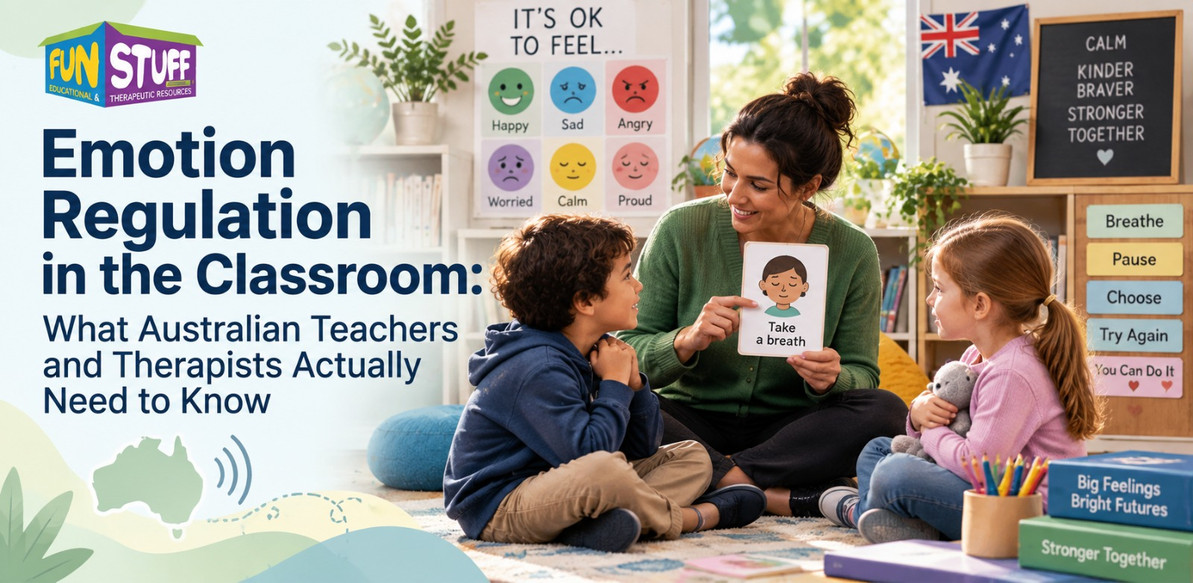
A calm corner in the classroom is one of the most practical things a teacher can set up, and it doesn't need to be elaborate. The important thing is that it's clearly not a punishment space. It's just somewhere a child can go to get their system back to a state where they can participate again. A spikey sensory ball, a weighted animal, a couple of fidget tools, a simple feelings chart. Physical input like this settles the nervous system faster than words usually can, especially when a child is in the middle of it.
Stay regulated yourself.
A calm adult actually settles a dysregulated child’s nervous system. Not as a figure of speech. It’s a real physiological thing. So getting low, keeping your voice quiet, giving them space, and waiting until they’re back before you try to have any kind of conversation, that’s not letting them off the hook. It’s the only approach that actually reaches them. Trying to reason at peak overwhelm doesn’t work. It usually makes things worse.
Watch for the Early Signs
Learning what one specific child’s warning signs look like, and stepping in quietly before things build, stops a lot of situations before they become situations. It takes time to figure out. But knowing a child’s early signs well enough to act on them is probably the most practically useful thing a teacher can develop over a school year.
What Therapists and Counsellors Can Do
In a therapy setting the work is more targeted. The aim is to give a child more tools, more language for what's happening inside them, and more awareness of their own patterns so they can catch things earlier.
Zones of Regulation
Zones of Regulation is probably the one you’ve already come across if you work in Australian schools. Four colour zones, each representing a different emotional or alertness state, built around helping kids identify where they are and what gets them back to green. The reason it works in practice is that so many schools have picked it up at a whole-school level. When a child hears the same language in the classroom, the therapy room, and out on the oval, they can carry what they’ve learned between those spaces.
Building Feelings Vocabulary
A child can't work with an emotion they don't have a name for. Building emotional literacy, the vocabulary for feelings and the ability to identify them, comes before any regulation strategy can stick. The How Are You Feeling Today? resources from Fun Stuff Educational and Therapeutic Resources are practical for both classroom and therapy use. They help kids understand that the full range of emotions is normal, while gently building the language they need to actually talk about what's going on.
Structured Work for Anxiety and Anger
For kids where anxiety or anger is the main issue, the Exploring Feelings programs from Fun Stuff give therapists a solid CBT-based framework to work within. Structured enough to run consistently week to week, flexible enough to meet each child where they actually are.
Coping Skills
The Coping and Wellbeing range at Fun Stuff covers worry management, mindfulness activities for primary-age kids, and calm-down strategies in formats children actually want to pick up. The Kids’ Stress Toolbox is ready to run from the moment it arrives, no prep required, which matters when you’re already seeing six or eight children a day.
Sensory Tools Belong Here Too
Body and emotion aren’t as separate as we tend to treat them. Heavy work, deep pressure, rhythmic movement, these settle the nervous system in ways that talking often can’t match, especially when a child is right in the thick of it. The Sensory Diet Cards (2nd Edition) from Fun stuff includes activities that build both sensory and emotional regulation at once. OTs and speech pathologists in school settings increasingly use these alongside classroom support, and they’re worth knowing about even if sensory isn’t your main focus.
It Has to Be Whole School
Say one teacher has genuinely got this. Her room is steady, the kids know what to expect, and the child who usually struggles most is doing okay in there. Then the bell goes. That same child moves through three or four more classrooms across the day, each running differently, each adult responding differently. For a kid who already finds unpredictability hard, that variation across the day quietly undoes a lot of the good work.
The schools that handle this well haven’t done anything revolutionary. They’ve just committed to being consistent. The same words get used whether a child is in a classroom, the library, or talking to someone on the oval. There’s a space to settle that isn’t the principal’s office. The adults understand enough about what dysregulation looks like that they don’t meet it with frustration. And when a kid says they’re having a hard day, that lands with a nod rather than a lecture.
None of this happens quickly. And it almost never comes from a principal announcing it at a staff meeting. More often it starts with one teacher who tries something different, and a colleague down the hall notices, and then another one. It spreads slowly, but that's actually fine. Slow changes in schools tend to be the ones that stick.
Questions That Come Up
Does poor emotion regulation mean bad parenting?
No, and worth being clear about this because parents carry real guilt around it. Plenty of kids from warm, stable, loving homes find regulation genuinely hard. And plenty of kids who’ve had difficult starts manage it remarkably well. Parenting is part of the picture, but one part among many. Temperament, neurology, what’s happening at school, all of it plays in. Pinning it to parenting quality is usually both inaccurate and unkind.
When should a child be managing their emotions on their own?
There's no clean answer to this. The brain keeps building this capacity well into the twenties, so it's a long road for everyone. By primary school, most kids are getting better at handling small frustrations and waiting, with adult support still close by. If a child is noticeably behind where their peers are and it's making daily life hard, that's worth looking at with a psychologist or OT rather than waiting to see if they grow out of it.
What's the difference between emotion regulation and behaviour management?
Behaviour management is about the outside: what the child does and what follows. Emotion regulation is about the inside: building the capacity that shapes the behaviour before it happens. Both matter. But if you're only doing the first one, you're treating symptoms. A child who doesn't yet have the internal capacity to regulate can't just be managed into having it.
Where can I find emotion regulation resources for Australian schools and clinics?
Fun Stuff Educational and Therapeutic Resources has a solid range of emotion regulation tools chosen for real classroom and therapy settings. Zones of Regulation materials, structured programs, feelings resources, and sensory regulation tools. Browse the full emotion regulation and counseling range at funstuff.com.au.
Back to That Tuesday
The Year 3 boy came back in about ten minutes later. His teacher had figured out over the course of the year that making a big deal of the return made it worse. So she just gave him a quiet nod, slid a spikey ball onto his desk without comment, and kept the lesson going.
By lunch he was fine. He wasn't a bad kid. He just had a nervous system that needed more than the average classroom was built to give him, and he had a teacher who'd worked that out.
That's the work. Unglamorous. Slow. Sometimes you don't see the progress for weeks. But for the kids who need it, it's the thing that actually changes things.
If you want resources to support this work in your setting, Fun Stuff Educational and Therapeutic Resources
Recent Posts
-

Phonological Awareness: What It Is, Why It Matters, and How to Build It in the Classroom
A Year 1 teacher once said something to me that stuck: “He can read every word on the page, but he s …11th Sep 2026 -

Emotion Regulation in Children: Practical Strategies for Teachers & Therapists
It was a Tuesday morning. Math lesson, mid-session. A Year 3 boy, a bright kid who generally gets on …11th Sep 2026 -
Auditory Processing Disorder in the Classroom
Auditory Processing Disorder in the Classroom: A Practical Guide for Australian Teachers and Speech …14th Aug 2026