Play Based Learning Examples: Intentional Teaching Ideas for Early Childhood Educators
Play based learning is how most Australian early childhood services teach, but setting up the play is the easy part. The real skill is knowing when to step in, what to say and how to turn a child's idea into learning without taking it over. This guide shares practical play based learning examples for children aged about two to five, with the intentional teaching moves that sit behind each one.
What is play based learning? Play based learning is an approach where children learn through play they help to direct, while educators plan the environment, notice what children are trying to do and add language, challenge or materials at the right moment. In Australia it sits at the heart of the Early Years Learning Framework (EYLF V2.0).
Where intentional teaching fits
EYLF V2.0 treats play based learning and intentionality as one practice rather than two separate ideas. Play gives children ownership. Intentionality means the adult has a reason for what they set up, say and add.
The National Quality Standard describes intentional teaching as educators being deliberate, purposeful and thoughtful in their decisions and actions (NQS Quality Area 1). That doesn't mean scripting play. It means you can explain why the cafe has a menu board this week, or why you asked one child to count the plates.
Child led, guided and educator led play
It helps to picture three kinds of play sitting along a line:
- Child led play. Children choose what to do and how. You observe, comment now and then and keep the space safe.
- Guided play. The play still follows the children's interest, but you set up a challenge, ask a question or add a material that stretches their thinking.
- Educator led experiences. Short, planned moments such as a group game that introduces a new rule or a story that brings in new words.
A good day usually includes all three. The skill is moving between them based on what you notice.
Play based learning examples across the day
Each example below shows the play, what children can learn from it and the intentional teaching move that lifts it.
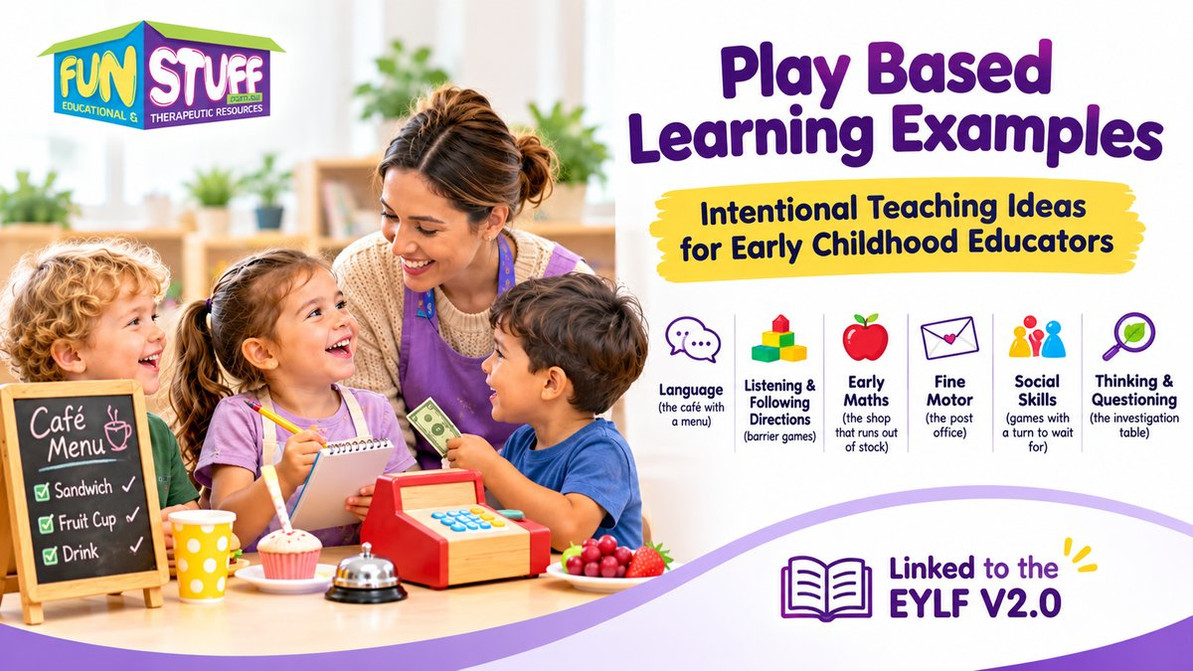
Language: the cafe with a menu
A home corner becomes a cafe after children mention going out for breakfast. Add notepads, a menu board and a few real takeaway containers.
The intentional move: join as a customer and model rich language. If a child says "I want chip", recast and extend: "You'd like hot chips. Would you like them salty or plain?" Ask about sizes and positions too ("Can I have the big cup, the one on the top shelf?"). If you notice children mixing up words like big and small or in and on, our basic concepts resources give you short, focused activities to use alongside the play.
Listening and following directions: barrier games in the block corner
Two children sit facing each other with a low barrier between them. One builds a small structure and describes it. The other tries to build the same thing without looking. Then they lift the barrier and compare.
The intentional move: model the describing role first, and keep directions to two parts for younger children ("Put the red block on top of the blue one"). Afterwards, ask what helped: "Which words made it easy to copy?" For a ready-made version, the Magnetalk Match Up Adventures Kit with barrier bag is designed around this same speaker and listener game.
Early maths: the shop that runs out of stock
A fruit shop with baskets, a price board and play money gives children lots of reasons to count, compare and share.
The intentional move: create small problems for children to solve. "I need four apples for my order, but there are only two left. What should we do?" Use comparison words naturally: more, fewer, the same, one more. Children aren't doing worksheets here, yet they're working with number every few minutes.
Fine motor: the post office
Set up envelopes, stamps, stickers, hole punches, pegs and a posting box. Children write or draw letters, fold, seal and deliver them to friends.
The intentional move: add one material each week that asks a little more of small hands, such as tongs for sorting mail or a peg line for hanging parcels. Watch how children hold pencils and scissors and note who avoids the table. Our fine motor resources are a good place to find tools that add this kind of challenge to everyday play.
Social skills: games with a turn to wait for
Simple board or card games give children a reason to wait, take turns, cope with losing and celebrate others.
The intentional move: start with a small group of two or three and narrate what's happening: "Mia is waiting for her turn. That's tricky when you really want to roll." Before the game, agree on what to say when someone wins. If you'd like games built for this, browse our social skills games and resources.
Thinking and questioning: the investigation table
Put out a bowl of ice, some snails from the garden or a collection of seed pods. Let children explore before anyone explains anything.
The intentional move: ask questions you don't already know the answer to. "What do you think will happen if we put the ice in the sun?" "Why do you think the snail went under the leaf?" Questions like these invite reasoning rather than one-word answers. For children who find who, what, where and why questions hard to answer, WH Chipper Chat turns that practice into a game, and our questioning skills resources offer more options. You'll find two ready-to-use games in our guide to teaching WH questions through play.
Five intentional teaching moves that work in any play
- Watch before you join. A minute of observation tells you what the child is trying to do, so your input fits their idea instead of replacing it.
- Comment more than you quiz. "You've stacked them really high" keeps play going. A stream of questions can feel like a test.
- Recast and add one word. Repeat what the child said in a complete form and add one new word or idea.
- Think together. Stay with a child's idea for several turns of conversation, wondering aloud and building on each other's thoughts. Researchers call this sustained shared thinking.
- Add one thing. A new material, a problem or a role can move play forward without you taking charge.
For more on how adult talk during play builds children's language, read how shared play builds language skills.
Planning and documenting intentional play
Intentional teaching is easier to show when your notes link what you saw to what you did next. A short note works well:
Noticed: Leo and Ari building a tall tower that kept falling. Did: asked what made it wobble and offered wider blocks for the base. Next: add a ruler and a camera so they can measure and record their towers.
Notes like this connect naturally to the five EYLF learning outcomes. The tower example touches on Outcome 4 (confident and involved learners) and Outcome 5 (effective communicators). Over a term, they also show families and assessors how play leads to learning.
Choosing resources that support play
You don't need a resource for every outcome. Look for materials that:
- children can use on their own and with an adult
- work across more than one area of learning
- can be made simpler or harder
- stand up to daily use in a busy room
A small set of well-chosen games, cards and fine motor tools often gets more use than a cupboard of single-purpose toys.
When you're planning next year's program, take a look at Fun Stuff's basic concepts, fine motor and social skills ranges. They're chosen for educators, therapists and families, and we deliver across Australia and to New Zealand.
Frequently asked questions
Is play based learning the same as free play?
No. Free play is one part of it. Play based learning also includes guided play and short educator led experiences, with the adult planning the environment and joining in with purpose.
What is an example of intentional teaching in play?
An educator notices children arguing over who goes first at the playdough table and introduces a sand timer, then talks with them about how waiting feels. The play continues, but the educator has added a tool and language for a specific reason.
How does play based learning link to the EYLF?
EYLF V2.0 names play based learning and intentionality as a key practice, and play is one of the main ways children work towards the five learning outcomes, from a strong sense of identity to becoming effective communicators.
What age is play based learning for?
The EYLF covers children from birth to five and through the transition to school. Many Australian schools also use play based approaches in the early years of primary school.
Recent Posts
-
Play Based Learning Examples: Intentional Teaching Ideas for Early Childhood Educators
Play based learning is how most Australian early childhood services teach, but setting up the play i …10th Nov 2026 -
How Shared Play Builds Language Skills in Children
Children learn language through real interactions. A child may pick up a new word from a book, but t …12th Oct 2026 -
Word Finding Difficulties in Children: Signs, Strategies and Activities
A child with word finding difficulties knows a word but can't get to it when they need it. They migh …9th Oct 2026