How Shared Play Builds Language Skills in Children
Children learn language through real interactions. A child may pick up a new word from a book, but they learn how to use it by talking, listening, asking questions and sharing ideas with other people. That’s why shared play is such a natural place for language to grow.
A small Australian study published in September 2026 looked at children aged three to five watching Play School with an adult. The researchers found that when adults pointed, commented and asked questions, solo viewing turned into shared talk. Children’s engagement depended on the quality of those interactions, not just on watching (Kervin et al., Australian Journal of Language and Literacy). Shared play works the same way: the adult’s part in the conversation is what turns an activity into language practice.
It doesn’t need to be complicated. A short game, story, puppet activity or conversation gives a child plenty of chances to practise.
What is shared play?
Shared play is play that involves real interaction between a child and another person. It might be a parent joining in pretend play, a teacher running a language game with a small group, a therapist using a game to practise communication, or two children making up a story together.
The adult doesn’t need to run every part of it. Giving children room to make choices, start conversations and add their own ideas creates some of the best chances to communicate.
How does shared play support language development?
It gives children reasons to talk. Children use language when they need to explain an idea, ask for something, describe what they’re doing or say what should happen next.
It builds listening skills. During shared play, children listen to instructions, questions and other people’s ideas, and learn that communication is two-way.
It develops vocabulary. Adults can bring in useful words without turning play into a lesson. A pretend shop, for example, brings in customer, basket, price, receipt and choice.
It encourages storytelling. Pretend play and picture-based activities let children create characters, describe events and link one idea to the next.
It supports conversation. Children practise asking and answering questions, taking turns and staying on a topic.
It encourages flexible communication. When someone responds differently from what a child expected, the child gets a chance to explain, clarify, change their idea or try again.
7 simple shared play activities for language development
1. Run a pretend shop
Set out a few safe household objects or toy items and open a shop. Ask questions such as “What would you like to buy?”, “How many do we need?” and “Who’s the customer?” Then swap, and let the child be the shopkeeper.
2. Make up a puppet story
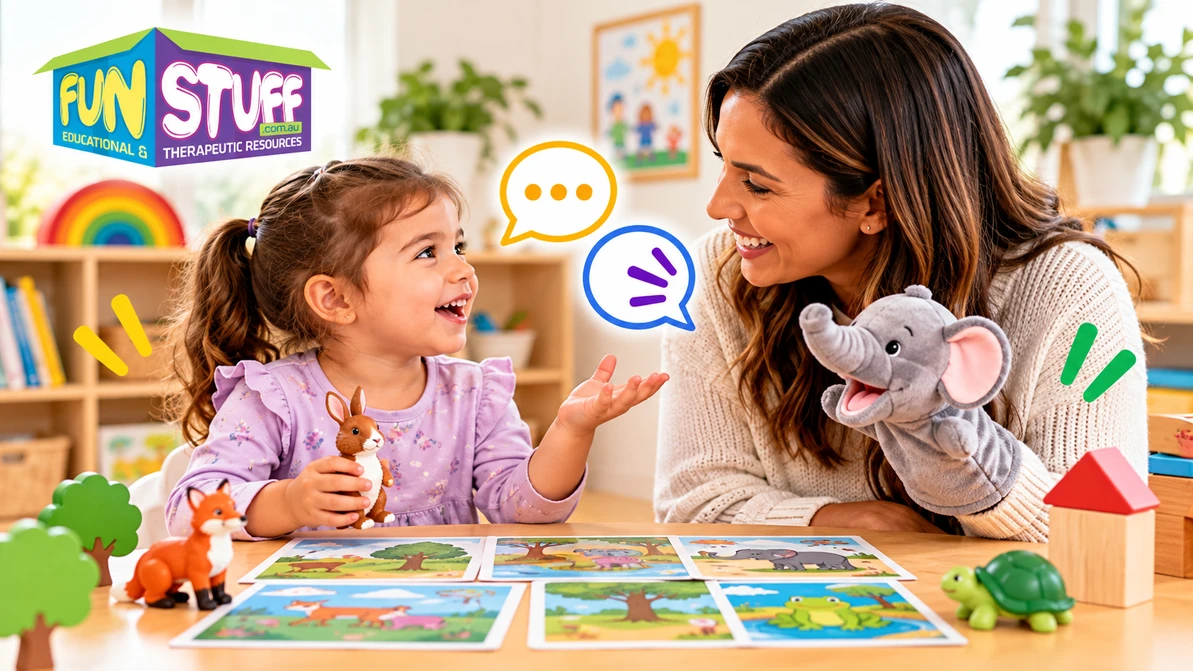
Use puppets or simple figures to create a short story together. Let the child decide what happens next. Pause along the way and ask what a character might say or do.
3. Play a question game
Pick a familiar topic such as animals, food or school, and take turns asking and answering questions. Start with simple what and where questions, then build up to why and how. For two ready-made WH question games, see our guide to teaching WH questions through play.
4. Build and describe
Use blocks or construction materials and ask the child to explain what they’re building. Encourage words for size, position, colour, shape and movement.
5. Finish the story
Start a story with one or two sentences and ask the child to carry it on. It doesn’t need to be a good story. The point is ideas, vocabulary and connected speech. The Victorian Government’s early childhood literacy toolkit describes storytelling as “an effective teaching practice for oral language development” (vic.gov.au).
6. Play a barrier game
Sit facing each other with a barrier between you, so neither player can see the other’s picture. One person describes where to put things or what they can see, and the other tries to match it. Then compare. Barrier games give children a real reason to listen carefully and use precise language, because a vague instruction gets a mismatched picture.
A book or folder makes a fine barrier at home. Ready-made kits such as MagneTalk Match Up Adventures Kit include matching scene boards, magnetic pieces and a barrier stand, and suit early childhood through primary years. MagneTalk Fantasy Story Adventures uses the same format with fantasy scenes, which works well for storytelling.
7. Talk about what happened
After an activity, ask the child what happened first, next and at the end. This simple routine practises sequencing, memory and storytelling.
How can adults make shared play more language rich?
- Follow the child’s interest instead of changing the topic too quickly.
- Add one or two useful words to what the child is already saying.
- Give the child enough time to answer before asking another question.
- Use open questions when the child is ready for them.
- Model a longer sentence without asking the child to repeat it every time.
- Comment on what the child is doing, not just ask questions.
- Take turns and let the child lead part of the activity.
- Repeat key words in different activities, so the child hears them used in more than one way.
What questions can adults ask during play?
Questions help children describe, explain, predict and connect ideas. Match the question to the child’s current language level rather than firing off a long list. Asking questions is also one of the strategies the Victorian Government toolkit recommends for keeping children engaged in storytelling.
- What are you making?
- Who is this character?
- What happened first?
- What do you think will happen next?
- Where should we put it?
- Why did the character do that?
- How could we solve the problem?
- What else could we try?
- How do you think the character feels?
Can language games support shared play?
Yes. Structured language games give children a clear reason to listen, speak, answer questions and take turns. They also make it easier to practise the same skill in different situations.
For question practice, Questioning Board Games cover who, what, where, when, why and how questions, along with speaking and listening. For older children, Topic Talk targets conversation, staying on topic, asking questions and commenting (recommended for Grade 2 and up). For more options, browse FunStuff’s language resources.
How can parents support language through play at home?
You don’t need to set aside a long lesson. Ten minutes of focused play together gives plenty of chances to talk. Follow what your child is interested in, talk about what you’re doing, take turns and let your child add ideas.
Everyday routines work too. Cooking together, getting ready to go out, packing a bag, looking at family photos or choosing a book all give reasons to describe, ask, explain and remember.
How can teachers use shared play in the classroom?
- Set up pretend play areas that call for specific vocabulary.
- Use small-group games where children have to listen and take turns.
- Have children retell a story using pictures or props.
- Use puppets to model conversations and social situations.
- Give children time to explain their ideas to a partner.
- Use question games during language groups and rotations.
- Let children create and tell their own stories.
For classroom ideas on the social side of talk, see our guide to pragmatic language skills in the classroom.
Frequently asked questions
What is shared play in child development?
Shared play is play where a child interacts and exchanges ideas with another person, whether an adult or another child. It can include pretend play, games, storytelling, building and conversation.
How can I encourage my child to talk during play?
Follow their interest, comment on what they’re doing, give them time to respond, add a new word or two, and ask questions that need more than a one-word answer.
Why is adult interaction important during play?
Adults model language, introduce new words, respond to the child’s ideas and help connect actions, words and stories. In the Play School study above, children’s engagement depended on the quality of the adult’s interaction, not just on the activity itself.
About this guide
FunStuff is a family-owned Australian business based in Melbourne, founded by a speech pathologist. It supplies speech, language and therapy resources to families and professionals across Australia and New Zealand.
Sources
- Kervin, L. K., Harrison, L., Taylor, E. & Stone, L. (2026). From screen to interaction: adult–child engagement with Play School, 60 years on. Australian Journal of Language and Literacy.
- Victorian Government: Literacy Teaching Toolkit for Early Childhood, Storytelling
This article is general information. If you have concerns about a child’s speech or language, talk to a speech pathologist.
Recent Posts
-

How Shared Play Builds Language Skills in Children
Children learn language through real interactions. A child may pick up a new word from a book, but t …12th Oct 2026 -

Word Finding Difficulties in Children: Signs, Strategies and Activities
A child with word finding difficulties knows a word but can't get to it when they need it. They migh …9th Oct 2026 -

School Readiness in Australia: What to Know
Every year, sometime in late January, prep teachers all over Australia meet their new class for the …15th Sep 2026