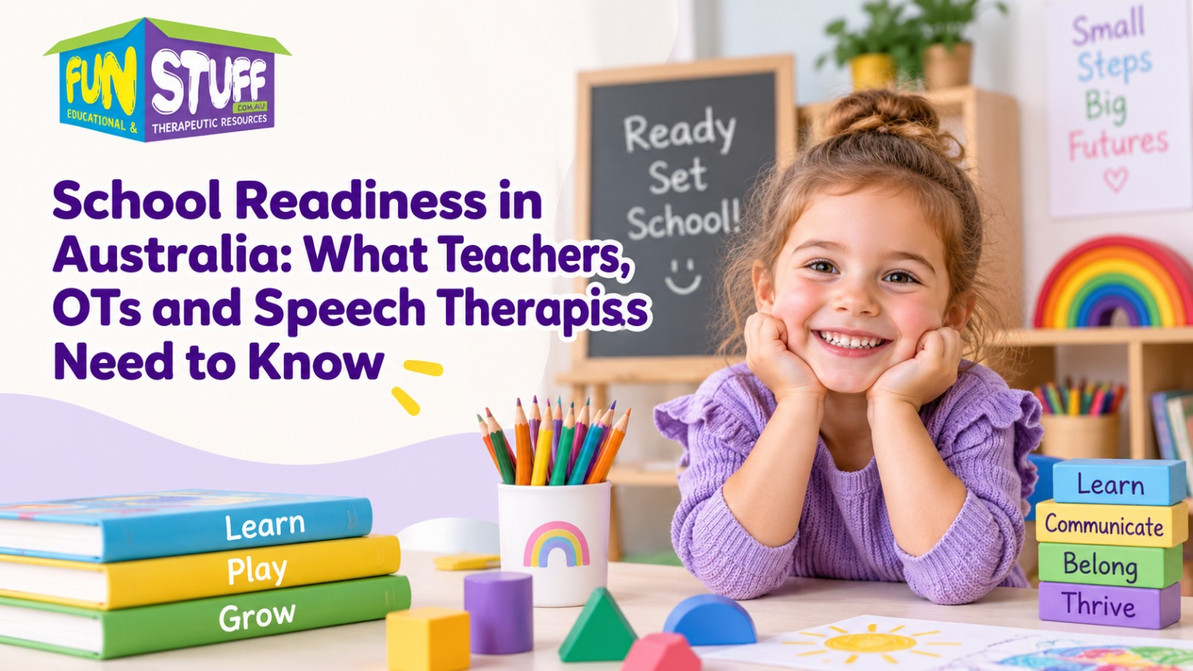
School Readiness in Australia: What to Know
Every year, sometime in late January, prep teachers all over Australia meet their new class for the very first time. And every single year, without fail, the gap between the most ready child in that room and the least ready one is bigger than most people outside education would ever guess.
It's not about who the smartest kids are. It is not really about which families did the most prep work at home. School readiness is messier than that, and far more layered. And it's the teachers, OTs and speech therapists who really get what's going on underneath that end up making the biggest difference, especially for kids who show up needing a bit more help.
So let's get into what this actually looks like in real classrooms, what the research is telling us, and what people on the ground can do about it.
So What Does “School Readiness” Even Mean?
People throw this phrase around constantly, and most of the time it gets reduced to something like: can the kid hold a pencil, can they write their own name. Honestly, that barely scratches the surface.
Most early childhood specialists and therapists will tell you school readiness actually breaks down into five areas that all feed into each other. There's social and emotional development, basically whether a child can hold it together through a group activity without falling apart. There's language and communication, so following a two-step instruction, having a proper back-and-forth chat, being able to make themselves understood. Cognitive skills come into it too: is the kid curious, can they problem-solve, will they stick with something for more than thirty seconds. Then there's physical development, the gross and fine motor stuff, sitting still, holding a pencil properly, managing scissors, getting through lunch without help. And finally self-care and independence: handling transitions, hanging up their own bag, actually asking for help instead of just melting down.
You'll notice letter recognition doesn't even crack the top of that list, and that's not an oversight. Study after study shows social-emotional skills, language and self-regulation are much better predictors of how a child settles into school than academic readiness in the strict sense. Put simply: a kid who can sit in a group, actually listen, hold it together enough to take part, and say what they need is going to do better than a kid who can write their own name perfectly but falls apart every time something changes.
Where Things Get Complicated
Here's the tricky part for teachers and allied health professionals working with young kids: school readiness isn't a box you either tick or don't. It is a profile. And every child's profile looks different.
One child might have strong language but real difficulty with self-regulation. Another is socially confident but significantly behind on fine motor skills. Some have strong cognitive skills but sensory sensitivities that make a busy classroom genuinely hard to be in. And some have speech delays that make it hard to join in, even when everything else about them is right on track.
That's why the more useful question isn't “is this child ready?” but “what does this particular child need to actually access what school has to offer?”
It's a question teachers, OTs and speech therapists are especially well positioned to answer. Not one of them alone, but together.
What the Data Shows Right Now
School readiness in Australia isn't improving in 2026. The Australian Early Development Census, which surveys children in their first year of school, keeps finding that a significant chunk of Australian kids are developmentally vulnerable in at least one area, most often around language and cognitive skills, and social competence.
Language delay specifically is worth calling out. Somewhere around one in five Australian children starting school have a language difficulty significant enough to affect their learning. Many of these children have never been seen by a speech pathologist. Some have never had their language formally assessed at all. They start prep carrying a gap nobody has ever put a name to, and teachers are left guessing why this particular child isn't keeping up, with no idea what's actually going on underneath.
The sooner these gaps get spotted and supported, the better things turn out. That is not a new finding. It has been in the research for decades. But the identification is still happening later than it should for a lot of children.
Language and Communication Readiness
For speech pathologists, school readiness is largely a language story. The communication skills that matter most when a child starts school tend to be:
- Following two- or three-step instructions in a group, not just one-on-one.
- Understanding classroom language: words like first, next, before, after, between, same and different.
- Telling a simple story: this happened, then this happened.
- Vocabulary that lets them understand what a teacher is explaining, and express what they want to say.
- Being understood clearly enough that adults and peers can follow what they are saying.
- Asking for help when they do not understand something.
A child who starts school with substantial gaps in any of these areas is going to find the language demands of the classroom really hard going. And since so much of early classroom learning is delivered verbally, language difficulties tend to ripple out across everything.
What Speech Therapists Can Do
For SLPs doing school readiness work, the focus tends to be on building the specific language skills that matter most in a classroom. Basic concepts, position words, time language, size and quantity words, are a solid starting point for a lot of children. The Basic Concepts resources available through Fun Stuff Educational and Therapeutic Resources cover this well, with illustrated activities that are structured enough to target specific concepts and engaging enough to hold a young child's attention.
For children working on following directions specifically, the Listening and Auditory Processing range at Fun Stuff builds this skill in a structured, progressive way. Sounds easy on paper. Then you actually watch a child try to follow directions in a busy classroom, and you realise how much is happening at once: hearing it right, holding it in their head, understanding every single word, and then following through, all while there's noise and movement everywhere around them.
For vocabulary, the Vocabulary Fun Decks from Super Duper Publications do the job well, easy to use in session and just as easy to send home for families to keep practising. And the cards themselves hold a four or five-year-old's attention far better than most worksheets ever will.
Fine Motor and Physical Readiness
OTs working with preschool-age children see this constantly: a child whose cognitive and language skills are right where they should be, but whose hands are not ready for what a classroom is going to ask of them.
Holding a pencil with a functional grip. Using scissors without the paper crumpling. Managing a lunchbox independently. Sitting with enough postural stability to write or draw for more than two minutes. These are all fine motor and gross motor tasks, and they matter practically for a child's ability to access the curriculum and manage their day.
The shift away from outdoor play and manual activity in early childhood, more time on touchscreens and less time on climbing frames, building blocks, playdough, and craft, has had a real effect on fine motor development in the children arriving at school. OTs consistently report seeing weaker hand strength and less developed pencil grip skills than they saw a decade ago.
What OTs Can Do
The Sensory Diet Cards (2nd Edition) from Fun Stuff are particularly useful here, especially for children whose sensory processing differences make a busy classroom hard to sit in. Building a sensory diet before school starts gives them strategies to manage their own needs from day one, rather than arriving without any tools at all.
For fine motor skill building specifically, activities that involve hand strength, pinch grip, and bilateral coordination are the most directly relevant to classroom tasks. The Fine Motor resources available through Fun Stuff include practical tools that OTs can use in sessions and recommend to families and early childhood educators for practice at home and in kindergarten.
Social and Emotional Readiness
This is the one that teachers talk about most, and for good reason. A child who cannot manage the social and emotional demands of a classroom is going to struggle regardless of what their cognitive or language skills look like.
Starting school asks a child to do a lot of socially and emotionally demanding things, often simultaneously. Sit with a group of children they do not know. Follow instructions from an adult they have just met. Wait their turn. Handle not getting what they want. Manage disappointment, frustration, and excitement without their parent nearby. Recover from conflicts with peers without adult intervention every single time.
For children with strong self-regulation, this is hard but manageable. For children whose regulation is still really developing, or who have anxiety, or who have not had many opportunities for group social experience before school, it can be overwhelming quickly.
What Teachers Can Do
The single most effective thing an early years teacher can do for children who are struggling socially and emotionally is to make the environment predictable. Clear routines. Consistent expectations. Explicit social rules. A physical space with some quieter corners available for children who need to step back. And a culture where having a hard feeling is something that can be said out loud, not something to be ashamed of.
When it comes to building the specific skills around naming and understanding emotions, the Emotion Regulation resources at Fun Stuff offer practical, classroom-ready tools that don't need any specialist training to use. Feelings charts, activity packs and structured games that help kids build an emotional vocabulary and name what's going on for them are an easy, high-impact addition to any prep classroom.
What Counsellors and Therapists Can Do
For kids who need more targeted support, especially those anxious about starting school, struggling socially, or facing bigger regulation challenges, the Social Skills range and Coping and Wellbeing resources at Fun Stuff give therapists structured tools to use directly, and to send home with families for extra practice. Getting this in place before the first day of school, instead of scrambling once problems have already taken hold, tends to make the whole transition a lot smoother.
The Professional Overlap
Probably the best change in how Australian schools approach school readiness is that real multidisciplinary collaboration is finally happening. Teachers, OTs and SLPs are all looking at the same child, just through completely different lenses, and when you actually put those views together, you get a picture no single one of them would have caught on their own.
Say a teacher notices a child struggling to follow instructions and chalks it up to behaviour. An SLP assesses the same child and finds a language delay that makes multi-step instructions genuinely difficult to process. An OT identifies that sensory sensitivity to the noise of the classroom is contributing to the child's inability to attend. Three different findings, all relevant, none of which was obvious from one professional's perspective.
This kind of collaboration works best when there are shared resources and shared language. When an SLP recommends vocabulary activities that a teacher can use during literacy time. When an OT provides a sensory diet that the teacher can incorporate into the daily routine without it feeling like a separate programme. When the communication between allied health and the classroom is practical rather than just happening in formal reports.
Questions That Come Up
My kid can count to 20 and knows all their letters, so aren't they ready?
Possibly. But academic knowledge is only one piece. How do they go in a group? Can they follow multi-step instructions? What happens when things do not go their way? How clear is their speech? Can they actually stay with a task for more than a minute or two without someone reminding them? That question matters just as much as counting to 20, if not more. Truthfully, a five-minute chat with their kindergarten teacher will tell you more than any list of milestones ever could.
So when should you actually raise concerns with an OT or SLP?
Earlier than most families realise. If a child is in their final year of kindergarten and there are concerns around language, fine motor skills, social skills or sensory processing, now is the time to act, not after school has already started. Hold off until prep to see how they go, and you've likely already lost months of early intervention time that could have made the whole transition easier.
What if the child has already started school and is clearly struggling?
Refer and act. Getting the child to the school's student support team, or directly to an OT or SLP, is the right move. This isn't something to just watch and wait on. Left without support, the gap between a struggling child and their peers only tends to grow, not shrink.
Where can I find school readiness resources for clinics and classrooms?
Fun Stuff Educational and Therapeutic Resources has a wide range of resources across language, fine motor, social skills, sensory, and emotion regulation that are relevant to school readiness work. Everything is selected for real professional use, not just general interest. Browse by category at funstuff.com.au to find what suits your setting and your children.
Those Two Children in the Prep Class
They both walked through the same door on the same January morning. One of them settled into the routine within a week. The other was struggling by Wednesday.
The struggling one was not less intelligent. He was not less loved. He just arrived with a profile that needed more support than the average classroom is set up to provide by default. His speech was a bit behind. His fine motor skills needed work. Groups were hard for him.
With the right support, identified early, provided consistently across school and home and therapy, most children like him do fine. The key word is early. And the key people are the ones who know what to look for and what to do about it.
If you are looking for resources to support school readiness in your classroom, clinic, or early childhood setting, Fun Stuff Educational and Therapeutic Resources has practical, professionally selected tools across every relevant area. Have a look at what is available at funstuff.com.au.
Recent Posts
-
School Readiness in Australia: What to Know
Every year, sometime in late January, prep teachers all over Australia meet their new class for the …15th Sep 2026 -
Phonological Awareness: What It Is, Why It Matters, and How to Build It in the Classroom
A Year 1 teacher once said something to me that stuck: “He can read every word on the page, but he s …11th Sep 2026 -
Emotion Regulation in Children: Practical Strategies for Teachers & Therapists
It was a Tuesday morning. Math lesson, mid-session. A Year 3 boy, a bright kid who generally gets on …11th Sep 2026